For Sponsors, CROs & Academic Investigators

Dosimetry that runs —
so your trial does too.

From pre-clinical scaling to First-in-Human, through early and pivotal phases — protocol design, site qualification, central analysis, submission reporting. So when patient data comes in and clinical decisions have to be made, the dosimetry is ready.

Scroll
Core Service
What We Deliver
Complete dosimetric analysis — with submission-ready reports.
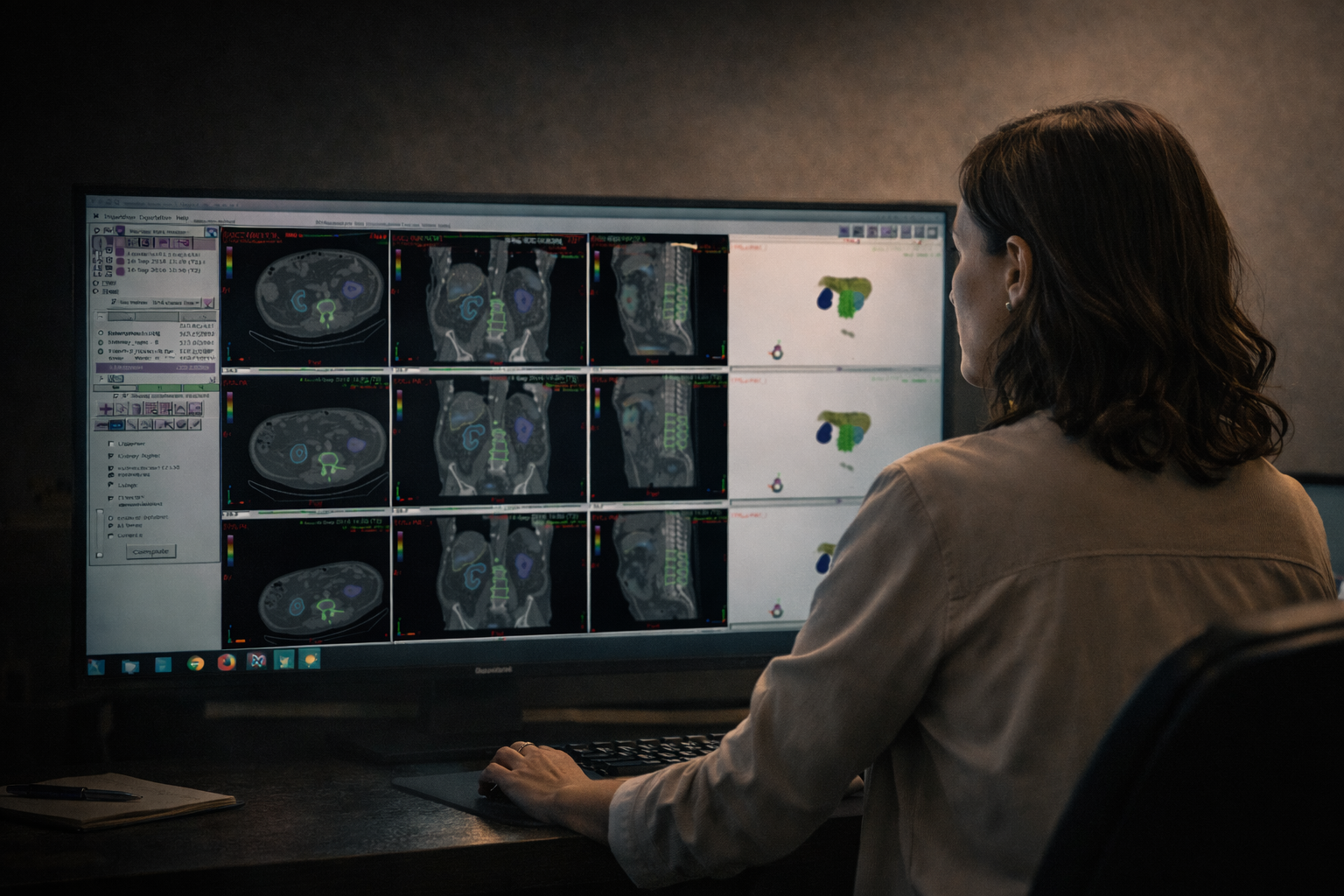
Organ segmentation and TAC fitting from reconstructed SPECT/CT
TIAC/AUC analysis — organ-level (OLINDA/EXM) and voxel-based (PLANET® Dose)
Absorbed dose (Gy) — organ, tumour, bone marrow
Dose coefficient (Gy/GBq) and effective dose (mSv/MBq)
Biokinetics & clearance — including urine analysis
Blood pharmacokinetics
Compliance & Standards
GCP-Compliant Audit-Ready Scientific Rigour

The full analysis. The right advice. On time.

For novel targets and new radiopharmaceuticals, we advise on organs-at-risk that may not be established in existing literature — drawing on our dosimetric and clinical experience to inform protocol design before the first patient is dosed. Every analysis goes through a structured quality control process covering imaging and treatment data, with peer review before any report is issued.

Reports are structured for regulatory review from the start — built alongside current FDA and EMA expectations around mandated dosimetry in trials. Turnaround is fast enough to feed results into Safety Monitoring Committee cycles, so dosimetry data is available when decisions are being made, not after them.
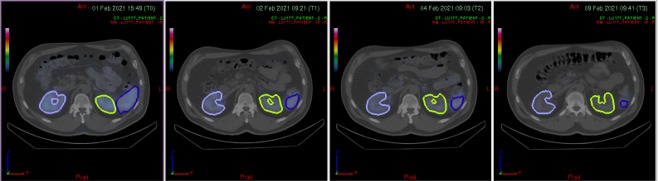
SPECT/CT showing 4 time points
Nuclide Experience
¹⁷⁷Lu ²²⁵Ac ⁹⁰Y ¹³¹I ¹⁶¹Tb ²¹²Pb ⁶⁷Cu ¹⁸⁸Re + diagnostic nuclides
Protocol, SOPs & Equipment

Consistent data across every site.
By design, not by chance.

Multi-site dosimetry fails when sites use different acquisition parameters. We eliminate that problem before the trial starts — designing scanner-specific protocols, writing equipment SOPs, and qualifying each site against the same phantom-based standard.

NEMA IQ phantom — recovery coefficient validation
Imaging Protocol Design

Hybrid, single-timepoint and multi-timepoint protocols tailored to nuclide and clinical constraints — collimator selection, energy windows, reconstruction parameters, calibration requirements.

Device SOPs & Equipment Standardisation

Radionuclide calibrators, gamma counters, well counters, phantom validation — unified across all sites. Two scanners, two SOPs, both validated independently.

Site Qualification & Training

Eligibility checks, setup support, and remote or on-site training. Each site is qualified before first patient. Sites are trained on the protocol — not just handed it.

Managed Rental Equipment

The equipment a site needs — without the procurement overhead.

Sites that lack specialist equipment for phantom studies and quantification validation can draw on our managed rental service. We handle logistics, insurance, and on-time delivery.

Dosimetry phantoms
Radionuclide calibrators
Well counters & gamma counters
Precision balances
Automatic Pipettes
Managed rental equipment — world map

Phantom studies — from methodology definition through protocol implementation to analysis — can be conducted by Oncosia on-site at the study centre, depending on territory.

EU US Central Asia Further territories — contact us
Discuss equipment needs
Pre-Clinical Dosimetry · Published Research

Pre-clinical dosimetry that holds up when it reaches the clinic.

From imaging protocol selection to absorbed dose scaling across species — pre-clinical dosimetry defines the assumptions that carry forward into first-in-human. Getting it wrong early is expensive. We have published on the methodology, not just applied it.
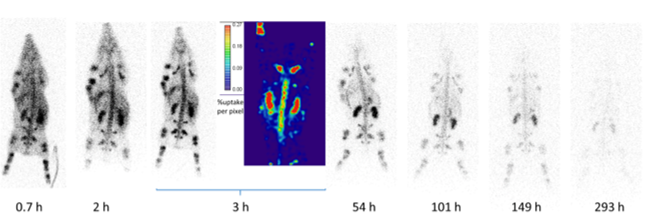
Beykan et al. 2022 — Is a single late SPECT/CT based kidney 177Lu-dosimetry superior to hybrid dosimetry? Physica Medica.
Beykan S, Tran-Gia J, Jensen SB, Lassmann M Physica Medica · European Journal of Medical Physics · Vol. 100, pp. 39–50 · 2022
¹⁷⁷Lu · Kidney Dosimetry · PRRT
Radiopharmaceutical [¹⁷⁷Lu]Lu-OPS201 (Satoreotide-tetraxetan, DOTA-JR11)
Imaging Protocols Compared A — Multi-timepoint SPECT/CT
B — Multi-timepoint planar + single SPECT/CT (hybrid)
C — Single late-timepoint SPECT/CT
Model & Validation 5 Danish Landrace pigs · [¹⁷⁷Lu]Lu-OPS201 injection · 97–113 MBq
3D-printed kidney phantom (University Hospital Würzburg)
Key Finding The hybrid protocol (B) is the best practical alternative to full multi-timepoint SPECT/CT. Missing the late imaging point (>~150 h post-injection) doubles the TIAC and dose estimate.
Why this matters for pre-clinical trial design

Imaging protocol selection in pre-clinical studies is not a technical detail — it directly determines the quality of the absorbed dose data that will inform first-in-human dose selection. A pragmatic but under-specified imaging schedule can double your TIAC estimate and the absorbed dose derived from it.

We also have direct experience with the scaling step itself — translating absorbed dose data across species using allometric and OLINDA/EXM-based methods. Choosing the right scaling approach for a novel radiopharmaceutical is not a formality. It requires understanding how the compound behaves in the animal model and what assumptions carry forward into the human dose estimate. This is the kind of methodological grounding we bring into pre-clinical dosimetry work.

Common Questions

Questions we hear before the protocol is written.

Technical, operational, and regulatory — covering what sponsors and investigators most often ask when they are evaluating a dosimetry partner for a trial.

As early as possible — ideally at protocol design stage, before the first site is qualified. Early engagement means the dosimetry sub-study is written correctly from the start: the right time-points, the right imaging parameters, the right biokinetics sampling schedule. Retrofitting a dosimetry arm into an existing protocol is always harder and sometimes produces data that cannot be used the way it was intended. We are available for pre-IND or pre-CTA consultations, including informal scoping calls that carry no obligation.
Yes — and this is where our pre-clinical and early-phase experience is most directly relevant. For novel targets, published literature on observed uptake patterns and established organ tolerance limits provides the scientific grounding for dosimetry protocol design. We draw on that evidence base — and on our own experience across early-phase programmes — to support protocol decisions with methodological rigour, rather than waiting for precedent that does not exist yet.
²²⁵Ac is among the most methodologically demanding nuclides in clinical dosimetry — primarily because the absorbed dose is delivered by decay chain daughters that redistribute after the initial injection, not by Ac-225 itself. We are well aware of the technical challenges this presents. We are currently developing and validating our ²²⁵Ac dosimetry methodology in collaboration with a partner site, working with actual patient data from an Ac-225-PSMA programme. Image reconstruction is performed using an in-house reconstruction framework with advanced point-spread-function modelling based on Monte Carlo simulation, which is undergoing validation. We are happy to discuss the current status and applicable scope in a direct conversation.
The right approach depends on the compound, the animal model, and the available data — and often on what method a sponsor has already used or committed to. Where a preferred scaling method exists, we assess whether it is well-supported by the available evidence and ensure the implementation is methodologically sound and regulatory-ready. Where the choice is open, we advise on the options. We have published on pre-clinical dosimetry methodology and bring that grounding to the FiH scaling step.
Segmentation is managed centrally by Oncosia as part of the analysis — sites do not need to submit contours. Where a central imaging core lab or sponsor physicians provide segmentations, we can incorporate those directly into the dosimetry workflow. For studies with a large number of lesions, we work with the investigator to agree which lesions should be included in the analysis. All segmentations are reviewed before dose calculation is finalised.
For informal results to support Safety Monitoring Committee decisions, turnaround is 3 to 5 business days from receipt of complete data. Formal cohort reporting depends on cohort size and analysis scope. Specific turnaround commitments are agreed per trial in the service agreement.
For voxel-based 3D dosimetry we use PLANET® Dose (DOSIsoft), a CE MDR Class IIb and FDA 510(k)-cleared medical device. For organ-level mean absorbed dose calculations we use OLINDA/EXM and IDAC-Dose, which are the standard tools referenced in EANM and IAEA guidance.
All tools used in the context of clinical trials are validated in accordance with 21 CFR Part 11 requirements and are continuously monitored for version updates that could affect analytical outputs. Reports are produced under our GCP-aligned quality system, with full traceability of data, software versions, and analyst review. We have supported FDA and EMA submission packages and welcome vendor audits.
Start the Conversation

Most dosimetry conversations start with
a single trial or a single nuclide.

Start there. We will tell you whether what we do fits what you need — and what it would take to make it work. No commitment required from that first conversation.